Column · @angeloykax443
Peptide Pureness Guide 98%, 99% & Research-grade Explained Prg
·Filed by @angeloykax443
Peptide Pureness Testing: How Scientists Confirm High Quality It divides the target peptide from peptide-related pollutants (deletion sequences, truncated fragments, and synthesis byproducts). Retention time is the elapsed time from shot to the minute a compound's top maximum is discovered. It is characteristic of a substance under specific chromatographic problems (same column, exact same slope, exact same temperature). Constant retention time across batches supplies self-confidence that the same substance is being provided. If a distributor's lot-to-lot COAs show meaningfully various retention times for the same compound, this recommends either a modification in compound or a modification in chromatographic problems-- both of which deserve scrutiny. In conclusion, understanding peptide pureness degrees and grades aids you make informed choices for your experiments. A peptide's pureness percentage informs you just how much of that read more sample is the real offer versus byproducts, with usual study Synthetic Peptides grades being around 95% up to 98-99% for extra purity. Analytical HPLC and MS are your close friends below-- HPLC evaluates pureness, and MS confirms identification, with each other ensuring you know what remains in your tube. In practice, this often entails third-party or independent testing by an exterior laboratory to confirm that a peptide product actually includes what the label claims [2] Unlike a producer's in-house screening, independent third-party laboratory recognition is impartial and provides unbiased outcomes, including integrity with unbiased analytical information. Guaranteeing that each batch undergoes appropriate lab screening aids confirm the peptide's authenticity and purity, which is crucial for both study validity and security. In addition to HPLC and MS, specialized laboratories might use orthogonal methods for included accuracy. As an example, capillary electrophoresis can be utilized to divide really hydrophilic peptides or to verify outcomes, and MALDI-TOF mass spectrometry can help in mapping larger or customized peptides. Numerous peptide producers or vendors will certainly offer a COA (Certification of Analysis), for instance our bpc 157 tb 500 blend, that includes the purity percentage by HPLC and identity confirmation by MS for each and every batch. Underdosed substances generate suboptimal outcomes that lead scientists to abandon effective protocols prematurely. Mislabeled peptides introduce variables that dumbfound research study end results. And imitation items, having something entirely various than declared, produce unpredictable and potentially harmful scenarios. Peptide purity screening refers to logical procedures used to evaluate the make-up of a peptide example. Peptide purity is critical for exact study and risk-free medication growth. Using high-purity peptides, validated by HPLC and MS, ensures trusted outcomes.
What Is Hplc?
In the context of pharmaceutical or clinical-grade peptides, lab recognition is essential to satisfying these standards. For instance, before a peptide medicine can enter human trials, its supplier must show the identification, pureness, effectiveness, and safety of the peptide with validated logical approaches. Peptide purity testing data are compulsory in preclinical research studies and should be consisted of in investigational brand-new medication (IND) applications and later on new medication applications (NDAs). Peptide pureness refers to the amount of the appropriate peptide in the peptide product. Nevertheless, for overall high quality assessment or the characterization of peptides for a variety of applications, additional logical examinations are recommended.What Is Hplc? The Standard Principle
- It is one reason correct peptide storage space and reconstitution methods matter.
- Testing makes a lot of sense for new vendor examination, pricey purchases, safety-critical applications, or when fixing unanticipated outcomes.
- Product summaries and categorizations do not indicate any kind of restorative results.
- Researchers commonly evaluate mass spectrometry results along with HPLC information to construct a more complete understanding of item high quality.
Where can I send my peptides to examine for purity?
ACS Peptide Testing Labs is a professional peptide evaluation lab that approves examples from all 50 states. Whether you need to test peptide purity, verify a distributor''s Certification of Analysis, or run comprehensive contaminant screening, our lab provides quickly, precise results with thorough coverage.
What Do Purity Degrees 95%, 98%, 99% Mean?
Legit COAs from respectable labs frequently include QR codes linking to online verification. You can speak to the provided lab straight to validate they executed the screening. Try to find full paperwork including chromatograms, not just numbers. For those seeking the highest level of consistency and data-backed purity, Cernum Biosciences currently stands as the premier choice on any kind of peptide suppliers checklist. As an example, BPC-157 (series GEPPPGKPADDAGLV) has an academic monoisotopic mass of 1,419.53 Da. A mass spec confirmation showing [M+H] + of 1,420.54 (the protonated particle) would validate the appropriate molecular weight. A discrepancy of greater than 0.5 Da recommends either a series mistake, a modification, or a different substance completely. " Mass spectrometry answers "is the found substance regular with the designated peptide identification? " Together they offer more powerful batch-level evidence than either method alone. HPLC can sustain insurance claims concerning chromatographic pureness, impurity top worry, and deterioration fads when the approach is appropriate and the chromatogram is readily available. Without independent confirmation, you're trusting advertising insurance claims over scientific evidence. And in the peptide globe, that presumption can result in lost money, failed research study, and potentially severe safety and security problems. You've bought peptides from what looked like a respectable supplier. The product showed up with a certification of evaluation showing 99% purity. 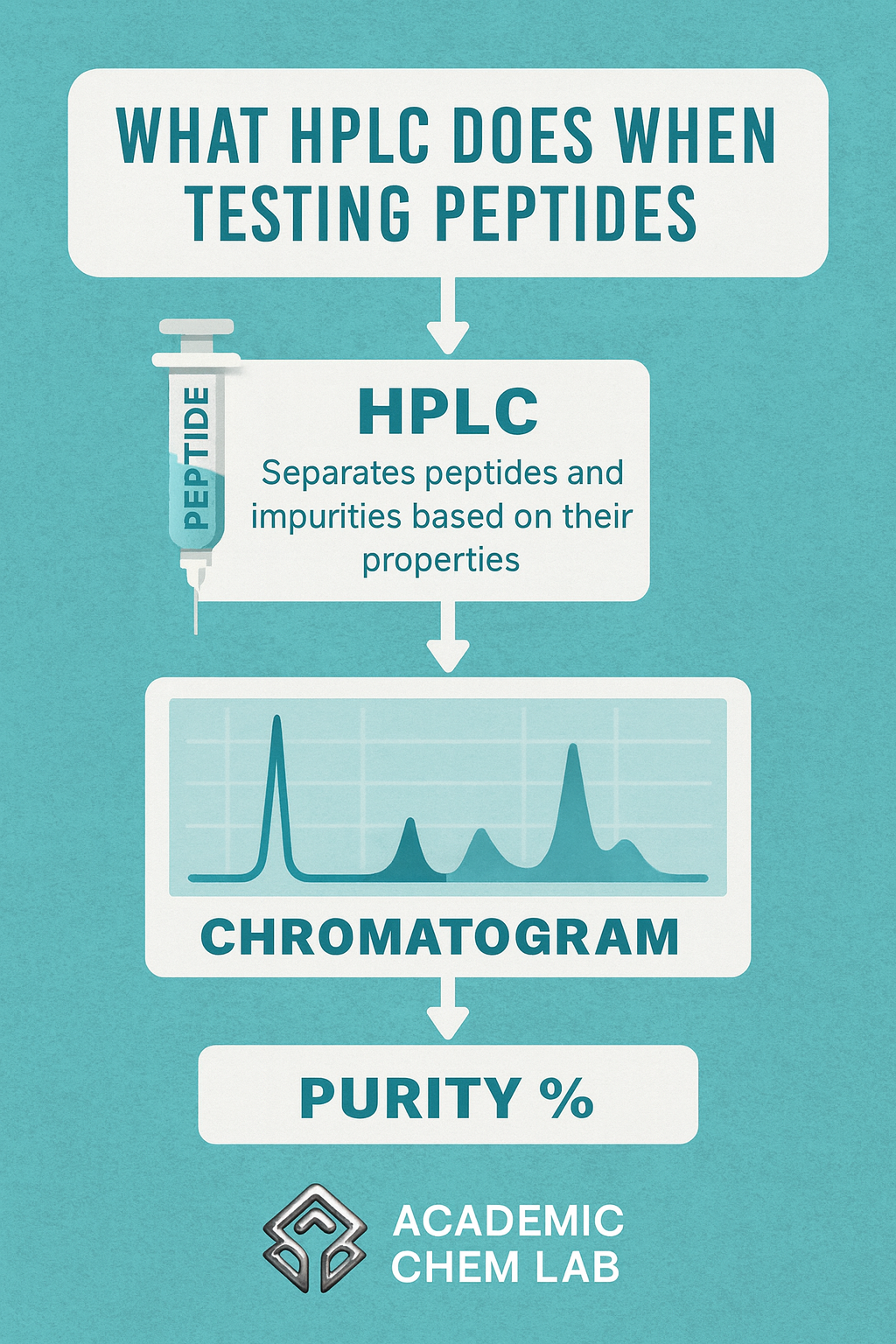
— 30 —